
The world of IT service management has just turned an important page. Announced in January 2026 by PeopleCert, ITIL 5 (or ITIL version 5) marks a major evolution of the most widely used framework in the world for ITSM (IT Service Management). Why this update? Because artificial intelligence is reshaping operating models, organizations have become digital first, and the boundary between digital products and services has almost disappeared. With an estimated total of more than three million certified professionals worldwide (itil.com), this new version directly affects IT teams in Switzerland and beyond. So, what exactly changes with ITIL version 5? And how can you prepare without losing the value of your current certifications?

Before diving into what’s new, a quick refresher is useful. ITIL (Information Technology Infrastructure Library) is a global framework for IT service management. Originally developed by the UK government in the 1980s, it provides best practices to align IT services with business needs.
Over the decades, ITIL has evolved. Version 3 structured everything around a service lifecycle. ITIL 4, released in 2019, modernized the approach by introducing the Service Value System (SVS), the service value chain, the seven guiding principles, and 34 management practices. This version also integrated Agile, DevOps and Lean methodologies into the framework (PeopleCert, 2026).
But the digital landscape has changed at an incredible pace since 2019. And that is precisely the reason for ITIL 5.

The global ITSM market is expanding rapidly. According to estimates from Grand View Research, it was worth around USD 13.5 billion in 2024 and is expected to reach USD 29.9 billion by 2030, with annual growth of 14.4% (Grand View Research, 2025). This growth is driven by digital transformation, cloud adoption, and above all the rise of artificial intelligence.
Organizations no longer manage only traditional IT services. They run digital products, automated workflows, and hybrid operating models. AI is transforming operations deeply, and an increasing share of ITSM solutions on the market now include AI capabilities.
As relevant as it is, ITIL 4 was not designed for an AI-first, product-centered world. That’s why an evolution was needed. And it truly is an evolution rather than a revolution: ITIL 5 builds on ITIL 4 instead of starting from scratch.
Now to the heart of the topic. Here is what distinguishes version 5 from its predecessor.
This is probably the most striking change. ITIL 5 puts AI front and center in its positioning and is expected to include structured guidance around AI governance and operational use. Artificial intelligence is no longer an optional add-on but a core element of the framework. In practice, this means the framework provides guidance to:
A dedicated new certification module, ITIL AI Governance, has even been introduced to help professionals address these issues. In Switzerland, where digital trust and data protection are particularly sensitive topics, this ethical governance dimension is especially relevant.

Until now, digital product management and service management often operated in silos. ITIL 5 brings both together into a single unified lifecycle. A customer-facing app, for example, is both a digital product and a service platform. The framework finally recognizes this reality.
This integration supports shared design, unified governance, and a smoother end-to-end digital experience. Product teams and IT teams can work with a common language and consistent practices.
IT performance is no longer measured only by uptime or the number of incidents resolved. Today, user satisfaction, journey smoothness, and overall experience quality matter just as much, if not more.
ITIL 5 places digital experience at the heart of its guidance. The goal is to help professionals design, deliver, and improve digital products and services with a clearer understanding of how different stakeholders perceive value.

Another notable shift is that ITIL 5 is no longer limited to IT. The framework explicitly expands into Enterprise Service Management (ESM), covering areas such as HR, finance, and logistics.
This is no coincidence. According to industry analysts, the ESM market is growing at an estimated 15% per year, driven by organizations looking to standardize processes beyond the IT perimeter (IntelMarketResearch, 2025). In Switzerland, where companies are often organized with strong cross-functional collaboration, this ESM dimension can be particularly valuable.
ITIL 5 further strengthens its compatibility with DevOps, Agile and Lean. The framework is designed to fit naturally into hybrid environments where agile product teams coexist with structured IT operations. The core concepts from previous versions remain: the service value system, the guiding principles, and the existing practices are still valid and are reinforced.

To clearly see the scope of the changes, here is a comparison table of ITIL 4 versus ITIL 5 across the key dimensions. (The table below reflects the known and expected direction of ITIL 5 based on PeopleCert’s initial communications.)
| Comparison area | ITIL 4 | ITIL (Version 5) |
|---|---|---|
| Overall positioning | Modern ITSM framework | Global framework for managing digital products and services |
| Scope | Mainly IT and services | IT, product, experience, business, transformation |
| Core logic | Service Value System (SVS) | Unified lifecycle Product + Service |
| Products vs services | Still clearly separated | One integrated value chain |
| Business orientation | Business value, often indirect | Measurable outcomes, lived experience, direct business impact |
| Customer / employee experience | Present but secondary | Core pillar of the framework |
| AI and automation | Lightly structured | AI-first, built-in AI governance |
| Governance | Classic (ITSM / IT governance) | Broader: AI, digital, transformation |
| Level of pragmatism | Conceptual and structuring | More operational, flexible and actionable |
| Agile / DevOps compatibility | Strong | Native and explicit |
| Target audience | ITSM, Ops, Service Managers | IT, product, CX, executives, transformation teams |
| Certifications | Multiple modules, sometimes complex | Clear role-based pathways (PM, MP, SL) |
| Transformation module | Partly integrated | Central and cross-cutting across all tracks |
| AI extension | Optional / absent | Official module ITIL AI Governance |
| Access to practices | Traditional documentation | 34 practices via PeopleCert Plus (subscription) |
| Continuity | — | Backward-compatible with ITIL 4 |
The takeaway is clear: ITIL 5 does not reject ITIL 4. Fundamentals, the SVS, the value chain, the four dimensions, the seven guiding principles, remain fully valid. In reality, version 5 extends and enriches them to cover topics that the previous version did not yet address (PeopleCert, 2026).
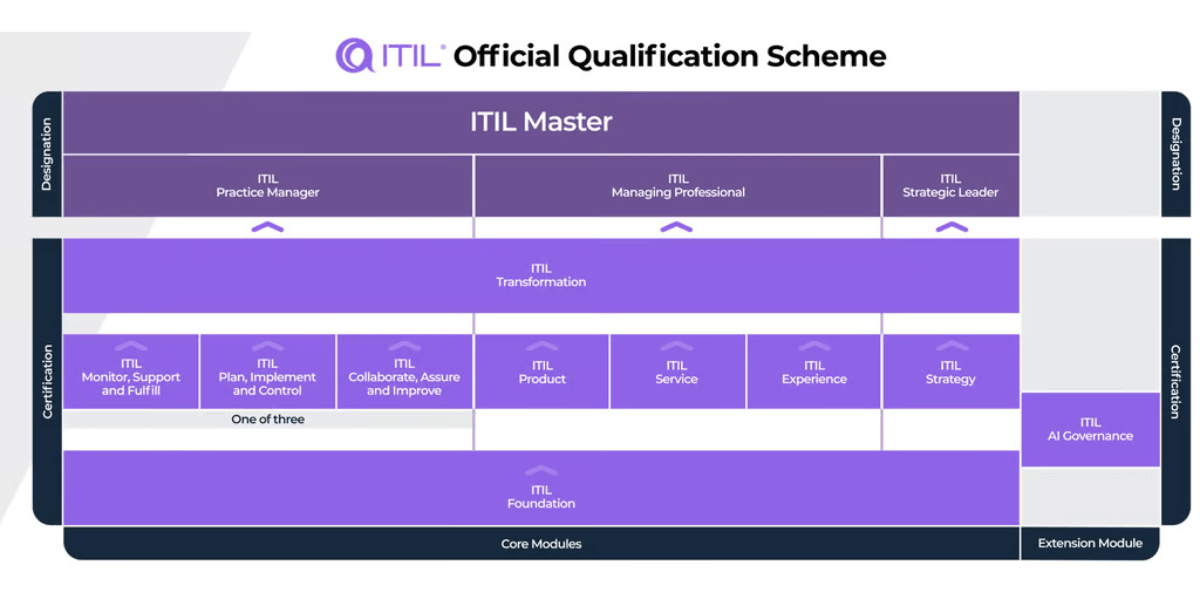
The certification scheme has been completely redesigned to improve clarity and consistency. It is now structured around three major professional tracks, each leading to a recognized designation. (Please note: these details may evolve as further official announcements are made.)
The three tracks and their designations
Each pathway is built on two shared pillars. ITIL Foundation is the entry prerequisite: without it (Version 5 or ITIL 4), you cannot access advanced modules. ITIL Transformation is the cross-cutting advanced module required in all three tracks. After these two foundations, professionals move into the track that best fits their role and goals:
The ITIL Transformation module is taken only once and automatically counts toward each designation you earn. Achieving all three designations (PM, MP and SL) unlocks the top title: ITIL Master.
In addition, there is an extension module dedicated to AI governance (ITIL AI Governance), reflecting the growing importance of responsible AI management within organizations.
Another major change is the assessment format. Foundation and AI Governance remain multiple-choice closed-book exams (PeopleCert is introducing a dedicated module focused on AI governance). For all other modules, Product, Service, Experience, Strategy, Transformation, as well as the Practice Manager certifications, PeopleCert has planned open-book exams. The goal is clear: to assess understanding and real-world application rather than pure memorization.
ITIL 5 certificates are issued with a three-year validity period. To keep them active, there are three options: earn 20 CPD points per year through the PeopleCert Plus subscription, pass another certification in the ITIL suite, or retake the same certification. This model encourages continuous professional development rather than one-off certification.
(Source: PeopleCert, official FAQ, 2026). All dates remain subject to change after the testing phase.
Good news: the ITIL 4 Foundation certification is still recognized as the prerequisite for all advanced ITIL version 5 modules. There is no need to retake the Foundation exam. ITIL 5 is presented as an evolution rather than a revolution, and ITIL 4 achievements remain fully valued.
Holders of a standalone ITIL 4 certification (without a full designation) can move directly into an ITIL 5 pathway aligned with their career objectives. For professionals certified in ITIL v3 Foundation, PeopleCert recommends taking the Version 5 Foundation course due to the many content changes.
The two versions will coexist for at least 12 months. No retirement date has been announced for ITIL 4. Unused ITIL 4 Foundation vouchers can be exchanged for Version 5 Foundation vouchers (PeopleCert, 2026).

The arrival of ITIL 5 is a concrete opportunity for professionals in French-speaking Switzerland. As a PeopleCert accredited ATO (Accredited Training Organization), ITTA offers official ITIL 5 training with certification included, delivered by accredited and experienced trainers.
The first available course is ITIL Foundation (Version 5), available since February 2026. This module is the entry point into the framework. It is aimed both at beginners and at professionals looking to refresh their knowledge. Training is not mandatory to sit the Foundation exam (self-study remains possible), but it is strongly recommended to fully absorb the new concepts and maximize your chances of success.
For advanced modules Product, Service, Experience, Strategy, Transformation and AI Governance, accredited training or official eLearning is mandatory before you can take the exam. ITTA will progressively roll out all of these modules according to PeopleCert’s official calendar.
With ITIL 5, the training offer also evolves in its underlying logic. The framework now addresses a broader audience: product owners, transformation managers, CX and EX leaders, business leaders, and executive management, alongside traditional ITSM profiles. ITTA supports this shift by offering modular pathways tailored to each organization’s needs, whether for individual upskilling or a transformation program for an entire team.
Switzerland, with its dynamic IT ecosystem and high concentration of international companies, is directly affected by this shift. Several aspects deserve attention.
First, AI governance becomes especially important in a country where data protection and transparency in decision-making processes are priorities. ITIL 5 provides a practical framework to support organizations on these topics, alongside the FADP (Federal Act on Data Protection). The new ITIL AI Governance module directly addresses the growing need to structure AI without slowing innovation.
Next, the ESM (Enterprise Service Management) approach aligns well with Swiss organizational culture. Many companies in French- and German-speaking Switzerland already work cross-functionally. ITIL 5 formalizes this by offering a structured framework that can be applied to HR, finance, facilities management, and more.
In addition, digital transformation challenges affect every key sector of the Swiss economy: public administration (where governance and traceability are essential), banking and insurance (regulatory compliance and customer experience), industry (automation and product-service integration), healthcare (digitizing patient journeys), and services. With its broader scope beyond pure IT, ITIL 5 provides a shared language for IT, business teams, and leadership, a real advantage in organizations where quality and concrete outcomes matter more than theory.
Finally, the strong Swiss culture of quality, governance, and compliance naturally aligns with the ITIL 5 philosophy. The framework brings internationally recognized structure, while remaining flexible enough to adapt to local specifics.

The short answer is no, not urgently. ITIL 4 remains valid and widely recognized. The transition is designed to be gradual. That said, it makes sense to start getting familiar with the key Version 5 concepts, especially the built-in AI approach and the unified lifecycle.
For teams launching a new ITSM initiative or planning to redesign their processes, it may be smart to align directly with ITIL 5 to benefit from the most up-to-date guidance. For everyone else, transitioning over the coming months is perfectly reasonable.
ITIL 5 is not a break from the past, but a logical and necessary evolution of the world’s most widely adopted service management framework. By placing artificial intelligence at the core, unifying the management of digital products and services into a single lifecycle, focusing on digital experience, and expanding governance, this version responds to the real challenges modern organizations face.
Moving from a purely ITSM mindset to a broader framework for managing digital products and services also opens the door to a much wider audience: product leaders, CX leaders, business executives, and transformation teams. For IT professionals in Switzerland, it is an opportunity to strengthen skills, broaden scope, and stay aligned with a fast-moving industry.
Your ITIL 4 achievements are not lost. Backward compatibility is built in, the transition is gradual, and certification pathways are now clearer. The key is to stay informed, anticipate, and choose the right moment to make the move.
Does ITIL 5 completely replace ITIL 4?
No. ITIL 5 is an evolution of ITIL 4, not a replacement. The two versions will coexist for at least 12 months. No retirement date has been announced for ITIL 4 (PeopleCert).
Is my ITIL 4 Foundation certification still valid?
Yes, absolutely. The ITIL 4 Foundation certification is recognized as a prerequisite for all advanced ITIL version 5 modules. There is no need to retake it.
Do I need mandatory training to take ITIL 5 exams?
For Foundation, training is not required by PeopleCert, but it is strongly recommended. Self-study is allowed. However, for all advanced modules Product, Service, Experience, Strategy, Transformation, AI Governance, and the Practice Manager certifications, accredited training or official eLearning is mandatory.
What does an AI-first approach mean in practical terms?
It means AI is built into the framework from the start rather than added later. ITIL 5 provides practical guidance for adopting AI responsibly, governing algorithms, and adapting operating processes accordingly. A dedicated module, ITIL AI Governance, is scheduled for release in May 2026.
Do ITIL 5 certifications need to be renewed?
Yes. ITIL version 5 certificates are issued with a three-year validity period. Renewal can be done through the PeopleCert Plus CPD program (20 points per year), by taking another certification in the ITIL suite, or by retaking the same exam.
Is ITIL 5 relevant for organizations outside IT?
Yes. One of ITIL 5’s key advances is its expansion into Enterprise Service Management (ESM). The framework can now be applied to HR, finance, logistics, and other business functions, not only IT.
Do I need to take the ITIL Transformation module more than once?
No. ITIL Transformation is a universal module shared across all three tracks (Practice Manager, Managing Professional, Strategic Leader). You only need to take it once, and it counts toward every designation you pursue.