

Will your team building bring the team together?
Five questions to know what to work on before the event.
1 / 5 — Why are you organising a team building this year?
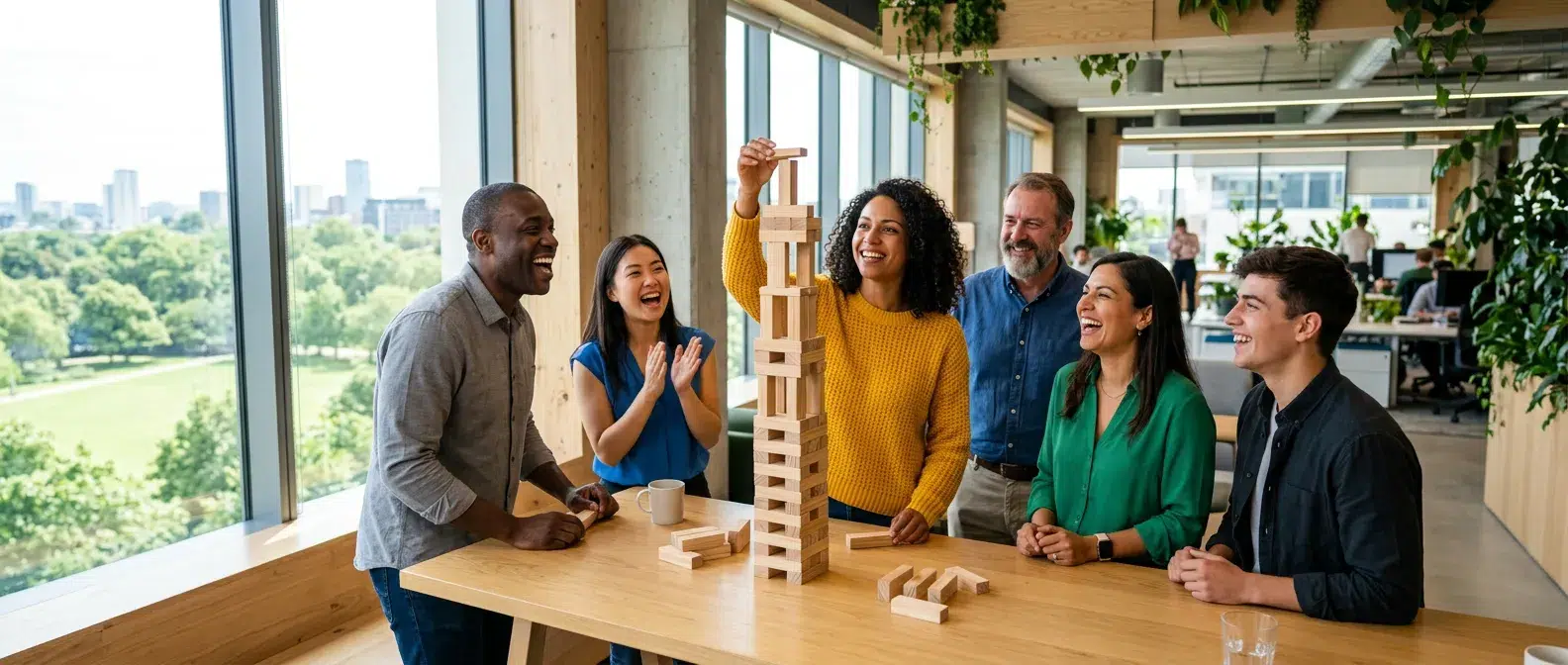
Every year, the same question comes up in November: what should we do for the team before the holidays? For many companies, team building then comes down to a meal, a fun activity and a few photos. It is a pleasant moment. But the following Monday, nothing has really changed.
However, a well-designed team building event can strengthen trust, clarify roles and revive cooperation. It all depends on the objective set at the outset. In other words, the activity matters less than what it allows people to work on together.
First, Swiss figures show that team bonds cannot be taken for granted. According to Gallup’s State of the Global Workplace report, published in April 2026, 15% of Swiss employees say they felt lonely a lot of the previous day. The European average stands at 13%. In addition, 34% of Swiss employees report a high level of stress during the previous day.
These figures do not mean that a team outing solves everything. On the other hand, they show that some employees work without really feeling supported. Remote work, teams spread across Geneva, Lausanne and other sites, or recent arrivals often make this worse.
Team building makes sense when it meets a specific need. For example:
Conversely, organising an event “because we do it every year” rarely produces lasting results.
Team building has been the subject of serious studies. In 2009, a meta-analysis published in the journal Small Group Research examined 60 correlations from earlier studies. Its authors conclude that team building has a moderate positive effect on all the team outcomes they studied.
Moreover, the strongest effect concerns affective outcomes, such as trust and attachment to the team. It also concerns processes, that is, the way the team cooperates, coordinates and communicates. The researchers also identified four components of team building.
| Component studied | What it works on | Example activity |
|---|---|---|
| Goal setting | Shared goals that everyone understands | Workshop on priorities for the coming year |
| Interpersonal relations | Trust and mutual listening | Paired conversations about the year’s successes |
| Problem solving | The ability to find solutions together | Timed group challenge |
| Role clarification | Who does what, and what each person expects of others | Mapping roles and expectations |
In practice, good team building works on at least one of these components. A purely recreational activity remains enjoyable, but it does not deeply address any of them.

A team evolves over time. Psychologist Bruce Tuckman described these stages as early as 1965, then completed them in 1977 with Mary Ann Jensen. The model now has five phases: forming, storming, norming, performing and adjourning.
This model helps you choose the right format. Thus, each stage calls for a different activity:
For example, offering a competitive sports challenge to a team in full storming risks deepening divisions. On the other hand, the same challenge can energise a team that is already close-knit.
A successful team building event takes preparation. Here is a simple method, which works for a team of five as well as fifty people.
Start with one question: what should change after the event? Getting to know each other better, cooperating across departments, preparing the year or simply celebrating? This objective then guides all the other choices.
Next, consult a few employees before deciding. A short survey is often enough. It avoids an imposed choice that nobody enjoys and builds support from the start.
Also think about everyone. A very physical activity excludes some people. Similarly, a late evening is a problem for parents or for colleagues who live far away. So favour a format in which everyone can take part without feeling left out.
At the end of the year, diaries fill up quickly. Book the date several weeks in advance. Ideally, hold the activity during working hours: the message is then clear, the event is part of the team’s work.
Finally, plan a short discussion at the end of the activity. What have we learned about the way we work? What do we want to keep? Note two or three concrete commitments, then revisit them at a team meeting in January.

The choice of activity follows from the objective. Here are a few ideas, grouped by what you want to work on:
Often, a combination works best. Indeed, a half-day workshop followed by a social moment brings together substantive work and relaxation. Employees thus leave with concrete decisions and a good memory.
Some mistakes come up often. They turn a moment meant to bring people closer into a source of discomfort.
An end-of-year party is a social moment, and that is perfectly fine. However, it does not replace real work on cooperation. If the team is facing tensions, drinks will not make them disappear.
Likewise, exercises that force people to open up in front of everyone make some employees uncomfortable. Trust builds gradually. So offer activities in which each person chooses how far to get involved.
In Switzerland, the question of accidents is also worth anticipating. According to Suva (source in French), an accident during a work event generally counts as an occupational accident, from leaving home until returning. However, clearly separate leisure phases fall under non-occupational accidents. For a sporting or risky activity, therefore, check your cover with your insurer before the event.
Finally, the most common pitfall remains the lack of follow-up. Without concrete commitments, the effect of the event fades within a few weeks. To anchor what the team gained, the manager must then keep these commitments alive day to day. Interpersonal skills play a major role here, as our article on emotional intelligence at work shows.

After all, cohesion is built mostly between two events. Understanding your team’s dynamics, preventing tensions, establishing shared values and ground rules: these levers are part of management. Our course Develop the performance of your team covers them over two days, in Geneva, in Lausanne or in a virtual classroom.
A successful team building event is not measured by the cost of the activity, nor by the number of photos shared. It is measured by what changes in the team afterwards: more trust, clearer roles, smoother cooperation.
Before the holidays, therefore, take the time to set an objective, choose a format suited to the stage your team is at and plan the follow-up. This preparation makes all the difference. Also discover our other Soft Skills courses for managers and teams.
What is team building?
It is an activity organised to strengthen how a team works. It can target trust, shared goals, problem solving or role clarification.
Why organise a team building event?
To integrate new employees, bring departments closer or revive cooperation. It is useful when it meets a specific team need.
Does team building really work?
A meta-analysis published in 2009 found a moderate positive effect. The strongest effect concerns affective outcomes, such as trust, and the way the team works together.
How do you organise a team building event?
Set an objective, consult the team, choose an inclusive format and book the date early. Finally, plan a discussion and concrete commitments.
Is an accident during a team building event covered?
According to Suva, an accident during a work event is generally occupational. Clearly separate leisure phases are, however, an exception.