
Where does your hybrid project stand?
Five questions to find what to act on first.
1 / 5 — Does your project already combine agile and the V-model?
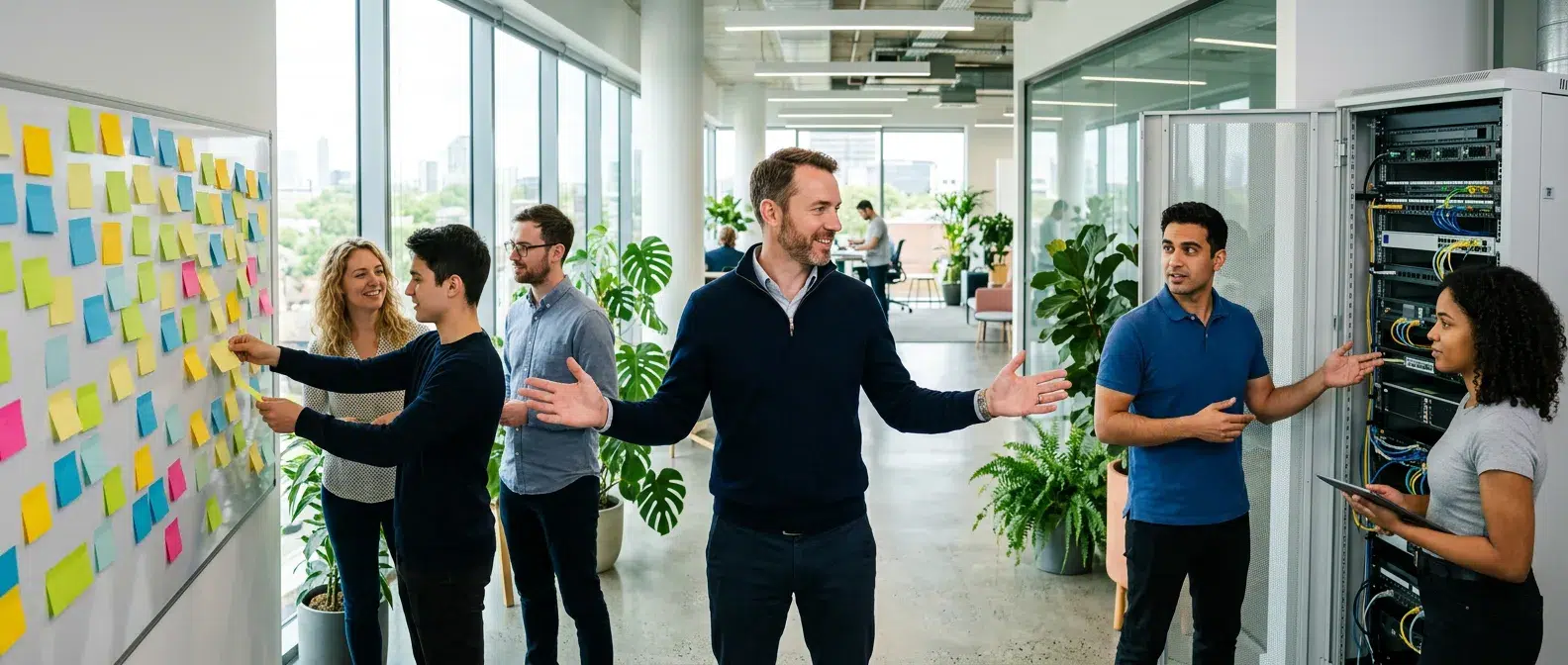
The “agile versus V-model” debate has long pitted two camps against each other. On one side, advocates of detailed plans and approved milestones. On the other, fans of short sprints and evolving scope. In the field, however, most projects do not choose. They mix both, often without saying so.
An annual budget, a fixed-price contract or a regulatory constraint imposes fixed milestones. Meanwhile, the software team delivers in iterations, because needs become clearer along the way. The project then becomes hybrid, often without anyone deciding it.
That is where chaos begins: two rhythms, two vocabularies and no clear link between them. This article explains how to make hybrid a deliberate choice. You will see how to split the project, organize governance and anticipate friction points.

The clearest signal comes from certifications. Indeed, the July 2026 PMP exam content outline devotes about 60% of questions to agile and hybrid approaches. The remaining 40% cover predictive approaches. PMI therefore expects project managers to move comfortably between the two.
Switzerland is heading the same way. The federal HERMES 2022 method, used in public administration and beyond, supports either a classic or an agile implementation. Its own slogan sums it up: agile or not agile, with HERMES it is not a question.
These changes reflect a simple reality. Few organizations can run an entire project in a purely agile way. They also have to be accountable, stick to budgets and meet external deadlines. Public procurement, for example, often requires specifications and formal approval steps. Conversely, freezing every requirement up front no longer works for digital projects. Hybrid thus becomes the point of balance.
First, a clarification. A hybrid project is not an agile project without rules, nor a V-model with a daily stand-up added. It is a project where some parts follow predictive governance and others iterative delivery, by design.
In practice, three setups come up most often:
Chaos rarely comes from the mix itself. Rather, it comes from a hybrid that nobody designed. For example, a team works in sprints, but management expects a detailed eighteen-month schedule. Every sprint that changes scope then looks like a slip. By contrast, a hybrid designed from the start states what is fixed and what can move.
The first decision is how to split the work. For each workstream, ask yourself one question: are the requirements known and stable, or will they become clearer as you go? The table below helps you decide.
| Criterion | Leans V-model | Leans agile |
|---|---|---|
| Requirements | Stable and known up front | Unclear or evolving |
| Cost of change | High (hardware, contract, infrastructure) | Low (software, content) |
| External constraints | Regulatory, with fixed dates | Few date constraints |
| Access to users | Limited or occasional | Regular, with frequent feedback |
| Dependencies | Strong, with suppliers | Team autonomous on its scope |
A single project can therefore fall into both columns. For example, migrating data from a legacy system often follows a strict plan, with rehearsals and a cutover date. The user interface, on the other hand, benefits from being built in iterations, with regular feedback.
Keep one simple rule in mind: use the predictive mode where mistakes are expensive to fix. Save agile for areas where learning fast pays off more than planning everything.
Some workstreams do not clearly fit either column. This is often the case for an integration with a poorly documented legacy system. In that situation, start with a short exploratory phase in sprints. It helps clear up the unknowns. Then, once the risk is better understood, you can switch that workstream to predictive management, or keep it agile.

At the heart of a successful hybrid project lies a single governance. Admittedly, two teams can work at different paces. However, management must read one dashboard, with the same milestones and the same decision criteria.
PRINCE2 offers a useful framework here. In particular, it relies on managing by stages and managing by exception. In practice, the project board approves each stage and sets tolerances, for example on cost or time. As long as the team stays within these tolerances, it moves forward without escalating every decision. Our article on PRINCE2 7th edition details these principles.
PRINCE2 Agile goes further by combining this governance with agile practices such as Scrum or Kanban. Generally, the method recommends fixing time and cost, then flexing scope. As a result, the team delivers the essential features first, and the rest adjusts to the time available.
PRINCE2 Agile now exists in version 2. PeopleCert, which manages the certification, has announced the retirement of the version 1 certifications. The last day to take the exam is December 31, 2026. If you are aiming for this certification, prepare directly on the new version.

Even when well designed, a hybrid project creates areas of tension. Spotting them early prevents most conflicts.
A fixed-price contract often describes a fixed scope. Yet agile assumes that scope evolves. The solution is to contract on objectives and a budget envelope, rather than an exhaustive feature list. Also include a simple mechanism to swap one feature for another of similar size.
On one side, the board expects a percentage of completion, while the agile team talks in sprint goals. So translate sprint results into progress toward milestones. For example, show what the team has already delivered for the stage and what remains to be done.
In a V-model, acceptance testing comes at the end of the project. In agile, by contrast, each sprint produces a tested increment. You therefore need to decide who validates what, and when. A good practice is to have users validate each increment, then keep an overall acceptance phase before going live.
Who decides on content: the project manager or the product owner? Without a clear answer, they end up stepping on each other’s toes. Usually, the project manager keeps responsibility for budget, deadlines and interfaces. The product owner decides the order of features within the agreed frame. As for the Scrum Master, if there is one, they help the agile team follow the framework and ease exchanges with the other workstreams.
Finally, an agile workstream often depends on a predictive one, and vice versa. For example, the software team cannot test the integration until the infrastructure is ready. Make these dependencies visible in a shared schedule. A regular review between workstream leads also helps spot a blocker before it delays the whole project.

Consider a services company replacing its online customer area. The project includes three workstreams with very different constraints.
First, the hosting infrastructure and the connection to the billing system. These elements depend on a supplier, a contract and a cutover date. They therefore follow a predictive plan, with approved milestones.
Next, the portal itself. Customer needs become clearer as testing goes on. The team therefore builds it in two-week sprints, with a product owner from the customer service department.
Finally, the migration of existing accounts. It follows a strict plan, with two dry runs before the real cutover.
The steering committee meets at the end of each stage. It reviews a single dashboard: supplier milestones, features delivered by the portal team and migration status. Thanks to clear tolerances, the team can reorder features without calling a committee meeting. However, any delay on the cutover date is escalated immediately.
After a few months, the results speak for themselves. Exchanges with the supplier stay on track, because the milestones do not move. Moreover, the portal improves with every sprint thanks to feedback from pilot customers. Above all, the committee no longer discovers problems at the last minute.

Running a hybrid project thus calls for a dual culture. You need to master the predictive framework and truly understand agile practices. Here are the skills that make the difference:
In addition, several certifications validate these skills. The PMP now covers hybrid extensively, as our comparison of PMP vs CAPM explains. PRINCE2 Agile, for its part, focuses on combining structured governance with agile practices. Lastly, HERMES remains a reference for Swiss public projects. You will find all our project management courses on our website.
Hybrid project management is not a lukewarm compromise between two methods. When well designed, it gives each part of the project the pace that suits it. On the one hand, the V-model secures what is expensive to change. On the other hand, agile speeds up learning where needs evolve.
The key remains governance: one dashboard, clear tolerances and defined roles. Start by splitting your next project workstream by workstream, then decide how to run each one. In this way, you will turn an accidental hybrid into a chosen one. Try this approach on a pilot project first, then extend it to other projects.
What is hybrid project management?
It is a project that deliberately combines predictive, phase-based governance with iterative delivery inspired by agile, under a single governance.
Which parts of a project should follow the V-model?
Those with stable requirements and costly changes: infrastructure, hardware, data migration or regulatory constraints.
Is PRINCE2 Agile suited to hybrid projects?
Yes. It combines PRINCE2 governance with agile practices such as Scrum or Kanban. Version 2 replaces version 1, whose exams end on December 31, 2026.
Does the PMP cover hybrid?
Yes. Since July 2026, about 60% of PMP exam questions cover agile and hybrid approaches.
Who decides on content in a hybrid project?
Usually, the project manager keeps budget, deadlines and interfaces. The product owner decides the order of features within that frame. This clear split of roles is the foundation of any hybrid project management approach.